
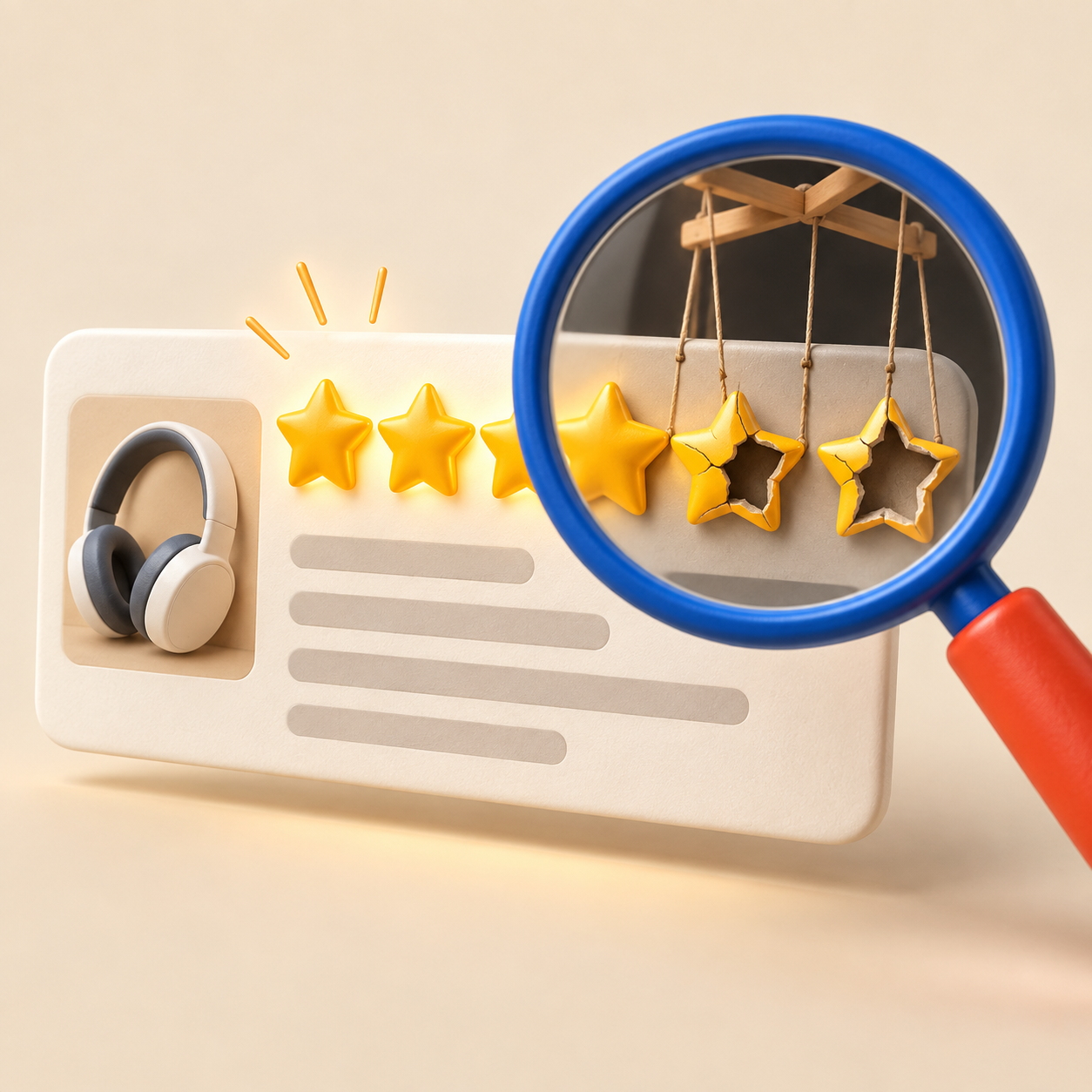
Five hundred reviews, 4.7 stars, and you still don't quite trust it. If that feeling sounds familiar, your instincts are probably right to be a little suspicious.
Fake reviews on Amazon are a real, well-documented problem, not just a paranoid feeling. The tricky part is that no single number tells you exactly how big it is. Amazon itself has said fake reviews make up a small fraction of the total, and the company reported blocking more than 250 million suspected fake reviews in 2023 alone. Independent researchers and review-analysis companies have put the number much higher, with some estimates suggesting a fifth or more of reviews on the platform show signs of being fake or manipulated. The gap between those numbers comes down to how each group defines "fake," but the takeaway is the same either way: enough fake reviews exist that it's worth knowing how to spot them.
What Does “Verified Purchase” Mean on Amazon?
You've seen this label. It means Amazon confirmed the reviewer bought the item through Amazon. That's it.
It doesn't mean the review is honest. It doesn't mean the reviewer wasn't paid or incentivized somehow. It just confirms a purchase happened. A review can be a Verified Purchase and still be planted, and a review without that label isn't automatically fake either, since plenty of genuine buyers use gift cards, buy through a company account, or received the item as a gift. Treat it as one data point, not a verdict.
Five Amazon Review Red Flags
Here's what actually tends to separate a fake review from a real one, based on patterns researchers and journalists have documented repeatedly.
Vague praise with no real details
A genuine review usually mentions something specific: how a strap fits, how loud a fan is, whether the zipper snags. A fake one tends to stay generic. “Amazing product, highly recommend” could be describing a blender or a backpack. It says nothing about either.
Phrasing that could belong to any product
Try this: could you copy the review, swap the product name, and paste it onto something completely different without it sounding odd? If yes, that's a warning sign. Real experiences don't transplant that easily.
A sudden burst of reviews
If a product jumps from a handful of reviews to hundreds within a short window, especially all clustered around five stars, that pattern doesn't usually happen organically.
A reviewer with a strange history
Click on the reviewer's name. If they've left glowing five-star reviews on dozens of unrelated products, often on the same day, that's a pattern worth noticing.
Language that's a little too enthusiastic for the product
A life-changing stapler should raise an eyebrow. Real reviews tend to match their enthusiasm to what the product actually is.
None of these signs alone proves a review is fake. But when you see two or three stacking up on the same listing, that's usually enough reason to look closer, or look elsewhere.
Check the Reviewer's History
This part takes under a minute and it's the single most useful habit here. Click the reviewer's name on any review that feels off. You'll see their review history. A normal shopper's history looks scattered: different categories, different ratings, spread out over time. A fake reviewer's history often looks the opposite: many five-star reviews, often in unrelated categories, sometimes posted within days of each other.
If you can't view a reviewer's history at all, or the profile looks brand new with no other activity, that's worth factoring in too.
Can Review-Checking Tools Help?
A few third-party services, like Fakespot and ReviewMeta, scan a product's reviews and flag ones that show these kinds of patterns. Some shoppers find them useful as a starting point. These are automated systems making educated guesses based on patterns, not a definitive fact-check, and they can get it wrong in both directions. If you use one, treat its output the same way you'd treat any of the red flags above: a signal, not a verdict.
The Best Defense Is a Better Habit
There's no perfect system here, not Amazon's, not a third-party tool's, not this checklist. What actually works is a habit: read a handful of reviews critically, check the reviewer's history when something feels off, and weigh the overall pattern instead of leaning on the star rating alone. That's slower than trusting a badge, but it's a lot more reliable.
Common Questions
What does “Verified Purchase” mean on Amazon?
It means Amazon confirmed the reviewer bought the item through the site. It doesn't guarantee the review itself is honest or unbiased.
Does Amazon remove fake reviews?
Yes, Amazon has ongoing enforcement against fake reviews and has reported removing hundreds of millions of suspected fake ones. Even so, some still slip through, especially on newer or less-monitored listings.
Can a product have both real and fake reviews mixed together?
Yes, this is actually the most common situation. Most listings with fake reviews still have plenty of genuine ones too. The goal isn't to write off the whole listing, it's to weigh the pattern rather than the star average alone.
Are five-star reviews more likely to be fake than others?
Fake reviews skew heavily positive, since their purpose is usually to inflate a product's rating. That doesn't mean every five-star review is suspect, but a wall of enthusiastic five-star reviews with little detail is worth a second look.
Do badges like “Vine Voice” mean a review is more trustworthy?
It means the reviewer is part of Amazon's early-reviewer program and received the product for free in exchange for an honest review. It's a different situation from a paid or incentivized fake review, but it's still useful to know the reviewer didn't pay for the item themselves.